
Introduction
This section provides a brief introduction to Machine Learning, including its basic meaning, real-world use cases, and the major types of Machine Learning. It helps readers understand how machines learn from data and how this technology is applied in different domains.
What is Machine Learning?
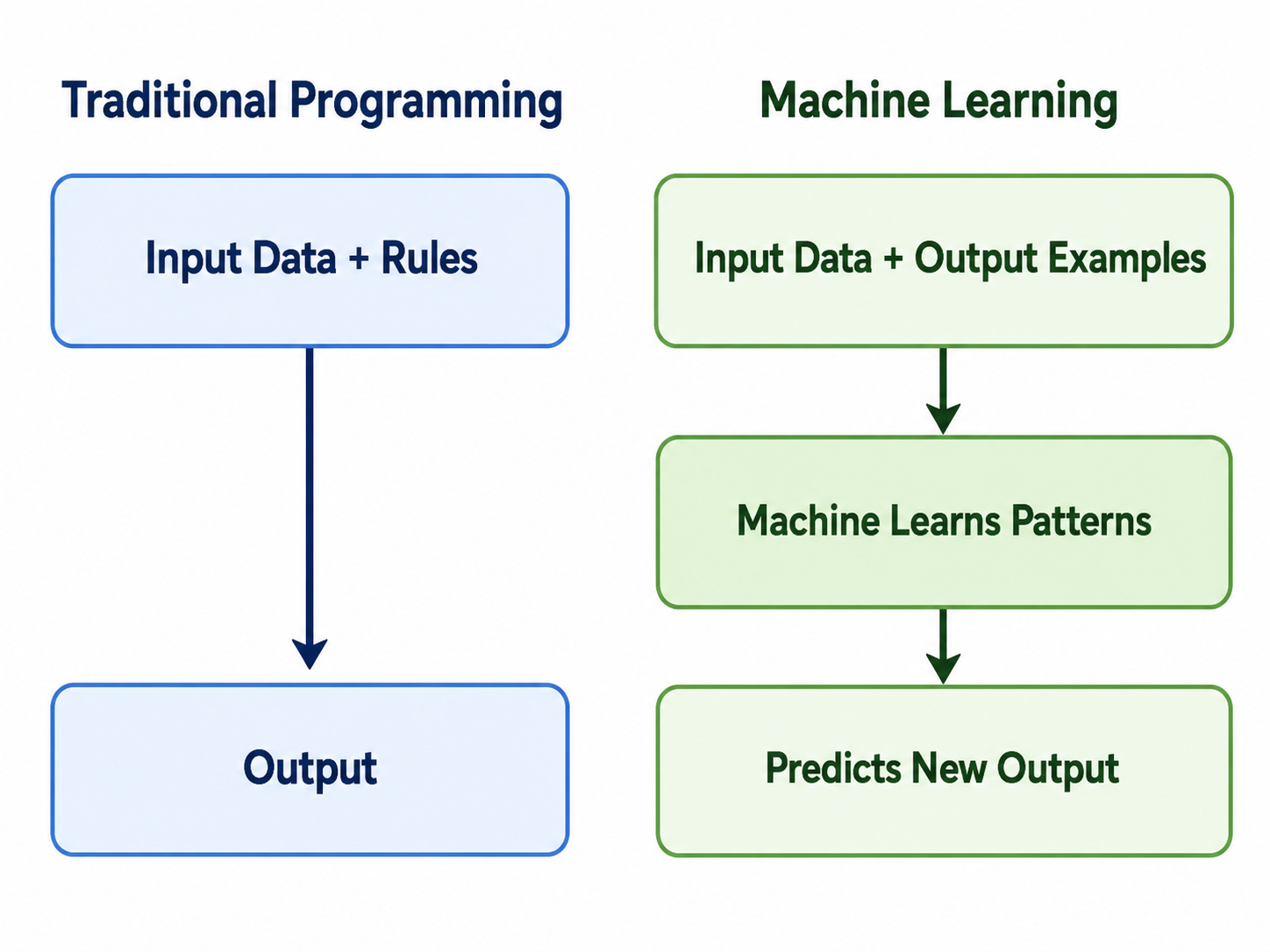
Machine Learning, or ML, is a part of Artificial Intelligence where machines learn from data instead of being directly programmed for every task.
In traditional programming, humans write rules.
In Machine Learning, the machine learns patterns from data and makes predictions or decisions.
3. Basic Meaning of Machine Learning
Machine Learning means teaching a computer to learn from past data and improve its performance over time.
For example, if we show a machine many photos of cats and dogs, it can learn the difference between them. Later, when we give it a new photo, it can predict whether the image is of a cat or a dog.
Basic ML Flow
Data
 |
 v
Training
 |
 v
Machine Learning Model
 |
 v
Prediction / Decision
4. What is Data Science?
Data Science is the process of collecting, cleaning, analyzing, and using data to find useful insights.
Data Science often uses statistics, programming, data visualization, and Machine Learning.
Data Science Process
Collect Data
     |
     v
Clean Data
     |
     v
Analyze Data
     |
     v
Build Model
     |
     v
Get Insights / Predictions
5. How Machines Learn from Data
Machines learn by finding patterns in data.
For example:
Past Data:
Hours Studied -> Exam Result

2 hours  -> Fail
4 hours  -> Pass
6 hours  -> Pass
8 hours  -> High Score
From this data, the machine may learn that more study hours usually increase the chance of passing.
When we give new input:
New Input: 5 hours studied
Prediction: Pass
6. Major Types of Machine Learning
Machine Learning is mainly divided into three types:
Machine Learning
        |
        |-- Supervised Learning
        |-- Unsupervised Learning
        |-- Reinforcement Learning
7. Supervised Learning
In Supervised Learning, the machine learns from labeled data.
Labeled data means the input already has the correct answer.
Example
Input: House size, location, number of rooms
Output: House price
The model learns from old house data and predicts the price of a new house.
Diagram
Labeled Data
(Input + Correct Output)
        |
        v
 Training Model
        |
        v
 Predict Output for New Data
Real-World Use Cases
- Email spam detection
- House price prediction
- Disease prediction
- Loan approval prediction
- Image classification
8. Unsupervised Learning
In Unsupervised Learning, the machine learns from data without correct answers or labels.
The machine tries to find hidden patterns or groups in the data.
Example
An online shopping website groups customers based on buying behavior.
Customer Data
     |
     v
Machine Finds Groups
     |
     v
Group 1: Budget buyers
Group 2: Premium buyers
Group 3: Frequent buyers
Diagram
Unlabeled Data
        |
        v
 Find Patterns / Groups
        |
        v
 Customer Segments / Clusters
Real-World Use Cases
- Customer segmentation
- Market basket analysis
- Fraud pattern detection
- Recommendation systems
- Document grouping
9. Reinforcement Learning
In Reinforcement Learning, the machine learns by taking actions and receiving rewards or penalties.
It is similar to how humans learn from experience.
Example
A robot learns how to walk.
If it moves correctly, it gets a reward.
If it falls, it gets a penalty.
Diagram
Agent
 |
 v
Takes Action
 |
 v
Environment
 |
 v
Reward or Penalty
 |
 v
Learns Better Action
Real-World Use Cases
- Game playing AI
- Self-driving cars
- Robot control
- Traffic signal optimization
- AI-based decision systems
10. Machine Learning Use Cases in Real Life
Machine Learning is used in many domains today.
Machine Learning Applications
        |
        |-- Healthcare
        |-- Banking
        |-- E-commerce
        |-- Education
        |-- Transportation
        |-- Cybersecurity
Examples
Healthcare
Machine Learning can help detect diseases from medical reports and images.
Banking
Banks use Machine Learning to detect fraud and approve loans.
E-commerce
Shopping apps use Machine Learning to recommend products.
Education
Learning platforms use Machine Learning to suggest courses and track student progress.
Transportation
Self-driving cars use Machine Learning to understand roads, traffic, and obstacles.
Cybersecurity
ML models help detect suspicious activities and cyber attacks.
11. Simple Example of Machine Learning
Let us understand Machine Learning with a small example.
Suppose we want to predict whether a student will pass or fail based on study hours.
Training Data:

Study Hours | Result
------------|--------
1 hour      | Fail
2 hours     | Fail
4 hours     | Pass
6 hours     | Pass
The machine learns the pattern:
More study hours = Higher chance of passingNow we give new data:
Study Hours: 5
Prediction: Pass
12. Conclusion
Artificial Intelligence helps machines perform smart tasks. Machine Learning is a part of AI that allows machines to learn from data. Data Science helps us collect, analyze, and use data effectively.
The three major types of Machine Learning are:
Supervised Learning      -> Learns from labeled data
Unsupervised Learning    -> Finds hidden patterns
Reinforcement Learning   -> Learns from rewards and penalties
Machine Learning is widely used in healthcare, banking, education, e-commerce, transportation, and many other fields. It helps machines make better predictions, automate tasks, and solve real-world problems.
https://github.com/AndroidSDKSources/android-sdk-sources-for-api-level-2/tree/master